Dec 15

waterdrop_1.jpgWe had the second meeting of the Social Media Club last night in Phoenix, AZ and I believe I can finally summarize the disconnect between old media marketing folk and the new media people who understand the essence of what social media is about. For the sake of this discussion, think of effective marketing as the art of spreading ripples of awareness throughout a glassy pond. If the goal is to cover as much surface area in as little time as possible, this is the critical distinction:

Old media folk are used to a one-shot, one-direction stone toss – you get one chance to lob your rock into the pond and watch the ripples as they emanate out from that. New media people realize that the pond has mud skippers and dragonflies in it, each capable of generating their own ripples and far more important than the waves generated from your toss are the secondary and tertiary ripples coming from the pond’s wildlife.

waterdrop_2.jpgThis rift in philosophies really is that basic. While old media folk will be perpetually looking for a bigger rock to heave into the pond in order to displace more water, how to optimize the trajectory of their throw to get a greater initial splash and how to aim it just right so it lands in the very center of the pond to yield the maximum potential coverage area, new media people will be thinking about ways to reach the wildlife with messages worthy of redistribution. Under the old media paradigm distribution was scarce and channels were controlled by a select few so the well-aimed boulder throw made perfect sense. Today distribution channels are limitless, it’s the attention that’s scarce and the transmissibility of the message is what’s important.

Understanding of the principles proposed in books like Tipping Point is critical. Whether you refer to the pond wildlife as Seth Godin’s sneezers, Guy Kawasaki’s thunderlizards, Malcolm Gladwell’s mavens, or Robert Van Arlen’s igniters – their role is the same: they are the second and third-generation ripplers that filter and relay your message to the rest of the pond (and ripplers talk with other ripplers). The primary determinant of the virility of your message is the value of the message itself. The level of credibility of the ripplers determine it’s tertiary transmission. Yes it’s helpful to connect first with high-ripple-potential wildlife but it does no good if you hit them with a boilerplate press release. Your message must represent clear and present value to that wildlife and the depth of that connection you establish with the rippler is everything. Traffic is of secondary in importance compared to quality of the connection established.

waterdrop_3.jpg As far as the Social Media Club, it’s an energetic group if not a bit overly so. There is an air of irrational exuberance that smells similar to when the dotcom craze struck as people started regurgitating buzzwords. Suddenly people think that blogs and wikis will solve world hunger and that blogging (the verb) is a sacred art form somehow different from writing. It should be no surprise that awareness and attendance of this group has ignited so fast given the nature of the subject matter. Last night had significantly more substance than the first though I’m happy to say. Francine who helped pull folks together as only she can, wrote up her take on the event and was right on with her comments. I’m planning to check out the next one as I am interested in this new press release style they’re talking about. It will be interesting to see how the group evolves.

Dec 14

We had Pat Sullivan over for an interview recently. Pat was the founder of the popular contact management and CRM systems ACT! and Saleslogix. Pat shared his experience with us in building both multi-million-dollar companies from scratch. Check out the audio for that conversation with Pat here. We’ve  had a string of solid guests on Venturecast recently- Fred Mapp, ex-CIO for AMD, American Express and Honeywell shared his story with us. And before him was the original founder of Scottsdale-based startup iTOOL, a company that ultimately sold to Onvia for $24MM in stock.  Jason’s audio interview is here.  If you have iTunes you can subscribe to Venturecast directly via iTunes by going here.

Tagged with:
Dec 14

9r_rounded_trans1.gifSo I was checking the server logs at 5am (because that’s what you do at 5am when you can’t sleep) and I noticed a spike in traffic from the 9rules.com domain. Digging further I came across this page on their site which lists the latest round of acceptances to their network. Wow. I’m peeing myself right now. This is the third time I have applied and I’ve been waiting to add their little 9rules flower to my sidebar for nearly two years now. Thank you Scrivs and Tyme for the add. Being the guy who was religiously picked dead-last in kickball and turned down by the fraternity the I rushed in college, it feels pretty freakin’ amazing to finally get accepted to a club ;-)
Dec 13

If you’re a developer or designer and haven’t checked out Cambrian House yet, you are missing out. This is a project eerily similar to the virtual co-op we were attempting with Grid7 Labs last year only they did a stellar job of telling the story, getting some VC money behind it and building up inertia with a solid community of contributors. I was interviewed recently for their “Movers & Shakers” section and they just posted our conversation as a podcast. There’s over 3500 ideas currently in their idea bin. I submitted a handful and two have been lucky enough to float into the top eight in the past two tournaments.

The one that’s in the running now in the Purple Cow Tournament is called “Disruptive Virtual Renderfarm” and you can read more about it on their site. The essence is the idea that the advent of utility computing for the public as afforded by Amazon’s EC2 service makes it possible for somebody to create a virtual render farm that could compete against existing outsourced render services like RenderNow.com that have heavy investments in physical infrastructure. Aside from having no fixed costs, the differentiators would be simplifying the render job submission process by creating hooks for each major animation packages and having a payment system that lets people pre-load their account and draw down as they order jobs. There’s good dialogue with people picking it apart but (fingers crossed) it will advance today to Round #3 of the tournament.

The incentive here is that the winning idea gets built and the original contributor and the people that submit code and designs earn ownership rather than contract rates. This is precisely what we hoped to create with Grid7 Labs – an environment for fostering innovation where the contributors would get not a paycheck but a stake in what they helped build. Where we diverged from CH in the model was in the decision to couple the roles of idea contributor with project manager and as we learned that was a critical error.

CH is not without its flaws – I’ve written a little about what I think they’re still missing, namely 3 of the 4 preconditions for the Wisdom of Crowds magic to work. In their defense though, we know first-hand what it is to try and run a virtual co-op; project managing these experimental developments and encouraging people who aren’t getting paid immediately to give up their Saturdays and evenings in order to contribute. All things considered, they’ve executed and actually shipped products. Guy Kawasaki says “Sales fix everything.” The equivalent statement in the world of virtual co-ops is that “Enthusiasm and community fixes everything,” and so far CH has built a phenomenal community. They continue to make all the right moves and their decision to form a “tribal council” of community members to help resolve the inevitable disputes that arise when people are submitting similar ideas is genius. It’s an honor to be listed as their latest “Mover and Shaker.”

Take a minute to setup an account if you don’t have one already, peruse the eight ideas competing in the tournament and cast your vote for the one you think should be built.

CHMoverShakerInterview.png
Dec 13

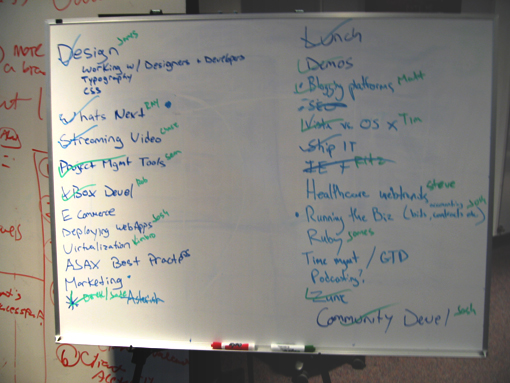
We held the first ever Barcamp Phoenix event on Saturday at the UAT and drew a crowd of about 40 at it’s highest peak of attendance. It was an unstructured, participatory event in which we collected a bunch of potential tech topics, triaged them and then assigned a moderator. We chunked them into 15min quick sessions and flashed through them- any people wishing to delve deeper after the time limit were free to wander off and form a break-away session. All in all, a very positive event and proof that useful conferences don’t require massive preparation and strict schedules and agendas to be useful. Here’s the whiteboard of topics we came up with – the checked ones are the ones that we covered:

BarcampPhxWhiteboard.jpg

Chris Tingom posted a rundown on his blog, a couple others have posted flickr photos. and Erica Lucci posted extensive notes on the day. You can bet there will be another one of these events again. As far as what we learned about logistics in running things- it’s decentralized so there’s no set tracks or authoritative figure but at the same time, somebody needs to take charge and move things forward when a topic is exhausted. Doing 15min fly over sessions and allowing people to break off and dive deeper is a good approach- our group whittled down to about 25 so we all stayed in the big auditorium as one unit but factioning into smaller breakouts would be sensible at the next one when there’s a larger crowd.

Keep your name on the wiki page if you intend to come to the next one. There was a company there that was capturing the video and projector demos by intercepting the VGA feed. They promise to post the sessions they captured once they’re produced and make them available via the Barcamp wiki. Thanks for everyone that attended. See you at the next one.

Dec 10

ScateredTodosMain.jpg

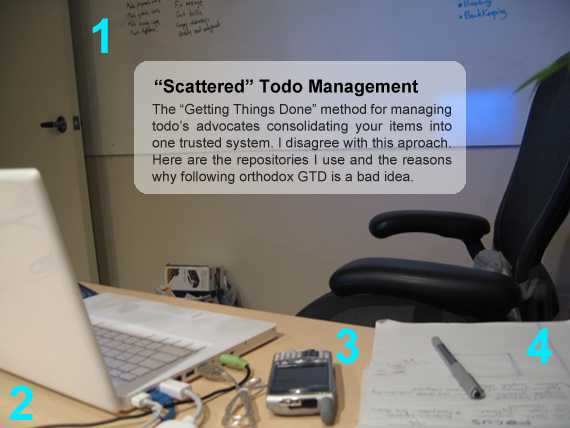
David Allen has a massive following with his “Getting Things Done” methodology for managing todo items. While it incorporates many good ideas, it’s troubling to see people expending a ton of energy to follow his system to the letter and wasting time wrangling their todo items into the "single trusted system" that he advocates. If it feels like you are contorting yourself for the sake of following the orthodox GTD methodology, consider using a "scattered" approach like this one. I completed GTD a year ago and took lessons from it but ended up with a homegrown approach that involves the above four repositories, each with its own function. I have been using this loose system now for the five months we’ve been running our startup and it has greatly simplified life and given me the "mind like water" state that David Allen proposes is achievable via GTD.

  1. Whiteboard – Whiteboards are collaborative tools that are good for brainstorming with others but they also make a perfect place to broadcast the current focus of each player on the team. This is consistent with Allistair Cockburn’s concept of the "" and serves as a single place where people can go to understand the current direction and focus of the team. I recommend the "dot size priority trick" for expressing priority of important items. Focus items should be established with input from each player and reviewed periodically to ensure they are not a mandate but rather an agreement.
  2. Ticket System – We use Trac extensively as our main hub for tracking tasks. Trac is the authoritative, multi-user system for all things important to your company. It integrates tightly with Subversion and there is a useful script that lets you close out tickets in Trac by entering "fixed #123" in the notes field as you commit files from SVN. We use Trac not only for development but for all facets of the business. We run Trac and Subversion over SSL and have both handled by the .htaccess for authentication. Both Trac and SVN can be driven by LDAP users. We currently use Skype for our office phone and record all important calls using Audio Hijack and then store the audio files in SVN. We also scan all critical business documents and put them in source control. Using a ticketing system gives you accountability and reporting so you know that nothing slips through the cracks and have a a way to see a "balance sheet" of the state of the tasks at any time.
  3. PDA – I have a Treo 650 and I use the Palm OS built-in todo list as "swap space" as I’m out and about thinking of new things that need to be done. If the todo is trivial and I can knock out in five minutes when I get back, I’ll do it and check it off without ever entering it into Trac. Otherwise, items get moved off the Treo and turned into Trac tickets once a day. I use Missing Sync and Bluetooth to synchronize everything in my Treo with my Macbook. The todos show up in iCal and you get a full backup of all the data in your PDA so you’re not hosed when it decides to take a swim.
  4. Legal Pad – Having a scratch pad on your desk is key. It’s the most frictionless way to take notes throughout the day and not give any thought to processing them into meaningful or actionable tasks. You are purely capturing the raw ideas as they occur in an unstructured (and ideally visual) fashion and minimizing the distraction from whatever it is you’re engaged in at the time. Mind mapping is a great technique to use with physical note taking but again, it’s worthless if you find yourself contorting your behavior just for the sake of using mind maps. Notes on the legal pad should be reviewed periodically and converted to either todo’s in the PDA or in the ticket system.

Nothing against GTD – it works for a lot of people and I’ve heard great things about Kinkless GTD. We should expect Omnifocus to be another solid app to come from the Omni guys. The point to consider though is that GTD has become a veritable religion when it should be thought of as a best practices framework of behaviors from which you develop your own system. Learn it but then synthesize it, chop it up and take the aspects you like piecemeal from it and other systems to create your own style. In the end it’s not how closely you can conform to orthodox GTD, it’s about how much you can accomplish while reducing stress and elimating the "open loops". I moderated a discussion yesterday on project management with Trac at the first ever Barcamp in Phoenix. If we get the video capture from that session, I’ll post it here in the comment field.

preload preload preload