Nov 04

Wow, the volume of commentary around the OpenSocial announcement last week is enormous. Let me explain why all the doomsday predictions for Facebook are off the mark. Here is an analogy:

Saying OpenSocial will kill Facebook is like predicting that Orbitz will kill SouthWest Airlines.

SWA still has superior value and user experience to any airline in the Orbitz consortium when it comes to reliable, affordable travel. And at the end of the day as a consumer of air travel you’re just buying a ticket and getting on a plane. Twenty-two competitors that have second-rate products don’t unite to form Voltron and having a bargain shopping aggregator doesn’t kill off the vendor who refuses to participate if he still has the best bargain for the customer. Likewise, having “one API to rule them all” is nice for developers writing applications for social networks but it takes more than that to make users of the abstaining network flee the place where all their friends are.

Josh Catone of ReadWriteWeb wrote an excellent analysis. Opening the platform and appealing to the developers to build applications is a tactic Facebook used to amplify their power and deliver the ultimate user experience while offloading the burden of developing compelling apps to external developers. Think of it as the development equivalent to a company’s reseller program only instead of leveraging external sales forces, they’re leveraging external development forces.

I share the same concern that Marshall Kirkpatrick expressed – for all the hype of OpenSocial, it doesn’t sound like it will truly be a 2-way street of open-ness as the name implies. It will be interesting to see how FB rolls with the punches but they shouldn’t have any more fear of OpenSocial than SWA has of Orbitz. They’ll participate when it makes sense. Maybe someone will write an abstraction layer that sits above FBML and OpenSocial XML? Maybe not and instead developers will have to write to both systems (like software vendors that write native Mac and PC installers)… Ultimately users go to the “clean well-lit place” that provides the best experience. As the industry moves inexorably towards open the underlying social network fabric becomes irrelevant (think IM channels – Gtalk, Yahoo, MSN, AIM, ICQ- irrelevant since Adium or Gaim is the interface that masks the underlying complexity). That Adium-equivalent for social networks will be the interesting piece at that point; a single dashboard that gives me one place to manage my digital identity easily in the way that Adium lets me forget what IM services I’m using and talk transparently to my friends regardless of the service they’re on.

Oct 25

Just curious. Here are the services for which I’ve written checks in the past month:

  • Rhapsody
  • LinkedIn
  • Flickr
  • iContact
  • Ning
  • AuthorizeNet
  • MyFax
  • Quickbooks Assisted Payroll
  • Adsense
  • StumbleUpon
  • There are a kajillion other free services I use but I’m interested in hearing which ones people find valuable enough to purchase.

    Oct 18

    Tuesday night I did a presentation for the San Diego Java User Group on how to use Trac to manage the development a software project. Below is a video capture of that talk (~45min). We cover the big picture of what’s involved in effective project management, the qualities of what makes a good tool and then we walk through hands-on usage of Trac in a real project scenario to demonstrate how it fulfills these objectives.

    I’ve also made the resources I used in the talk available for download including the slides, the notes and the final state of the from the demo so you can actually play with the exact data we used. Big thanks to Paul Webber for allowing me to present for the group. There were some great questions asked and I even learned some new stuff about Trac like the Mylyn Connector that allows you to interact with your tickets right from within Eclipse. There’s also a shorter video screencast that covers a subset of this talk (the screen is more readable than the projector in the video).

    Sep 30

    The book Made to Stick by the Heath brothers, Dan and Chip, is a safari tour of the elements of effective messaging. What is it that makes certain ideas resonate and survive while others immediately fade? Not surprisingly, the messages from the book themselves stick well and there were a ton of great stories with nuggets of insight in each.

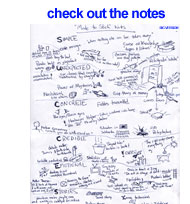
    Rather than try to hash through everything in a long post as I did with Buzzmarketing, I figured I’d try a different approach. I captured the notable stories on a single page via doodles that trigger a memory of each story and its meaning. I’ve scanned that page and created an image-mapped graphic with a text snippet summarizing each insight.

    The most interesting takeaway for me in reading this book is a “meta” realization that came not from anything particular within the book but rather from thinking about this book in relationship to other marketing books I’ve read (Anatomy of Buzz, Buzzmarketing, Freakonomics and Tipping Point). A discussion of that relationship merits it’s own post but the critical insight here is that for a message to be re-transmitted it must first stick with the recipient. The achievement of the sticking factor is a prerequisite for buzz-worthiness to ever be possible (ie. a virus endowed with traits that make it highly contagious will have zero effectiveness if it can’t survive within the host long enough to be spread).

    The takeaway is that we spend a great deal of energy trying to spread the word when we would be better served to improve the longevity of the word for the people that it reaches. It’s not what you come away with that ultimately matters- it’s what stays with you over time. Along the lines of a post I wrote awhile back called “If an elevator pitch falls in the woods…” – the weakest link of the re-transmissability of a message is its stickiness, not its buzz-worthiness. The notes I drew up from reading Made to Stick are mostly for my own edification of these concepts and to have a reference for the future, but hopefully you find them useful as well.

    Sep 24

    Wow. This thing is great on so many levels. With the exception of one conspicuously-missing feature, I’d say Apple has a game-changing device on their hands.

    The void that this product fills
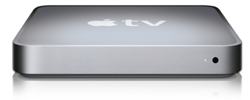

    On the continuum of multimedia-based, time-wasting activities there is a gap. If traditional television sits at the extreme of the passive / linear / spoon-fed type of media consumption, surfing the web and reading blogs is at the opposite end requiring too much effort and brain involvement for times when you just want to decompress. I just finished setting up an Apple TV box this evening and I’ve been playing with it for about an hour now and this thing falls squarely in the middle of that continuum as an easy way to consume digital multimedia without having to sit in front of a computer screen.

    The Apple TV allows you to sync your iTunes via wireless and watch/listen via your entertainment system. It can aggregate media from multiple computers, display photos and album art in the background and has an interface for surfing youtube content (provided it’s connected to the Internet). There was an Apple TV at a birthday party I was at last weekend and it was a blast passing the remote around and be able to pull up an old SNL episode or Mr. T singing about his mom. In the same way that the Nintendo Wii transforms a typically anti-social activity of gaming into a social experience, the Apple TV makes for a fun way of exploring digital content.

    Setup happiness

    The setup was almost as painless and intuitive as configuring a JumpBox. Running the wires for the component video took the longest time of any step. Once we got the wiring right the on-screen setup of the Apple TV from that point was a snap and took all of about 30sec to connect to the hotspot and start syncing to my iTunes. We did have to disable mac address filtering for it to connect. You pair it like you would a bluetooth device by entering in a combo on the iTunes of the computer which you wish to sync and it does its thing. About an hour later it had successfully synced some 2000 songs, a handful of video podcasts and a movie. You’ll want to pull down the album artwork for your iTunes library if you don’t already have it because it makes flipping through your music feel like flipping through a CD collection.

    Usability

    The visual interface is clean and what you’d expect from Apple. The remote is the same one that comes with the MacBook laptop and has only a few buttons- it makes the universal remote on the coffee table look like a monster. You navigate a tree of options based on Music, Movies, TV shows, Podcasts, Youtube and device settings. The only thing that’s awkward is typing in characters for a Youtube search via an on-screen keyboard.

    Valuable real estate for Apple

    I don’t know the numbers on prevalence of Apple TV’s at this point- I would guess it’s just a sliver of the market. But this device represents the “last mile of track” for Apple in a digital entertainment railway into the living room. I can see how owning the iTunes player, the iTunes store and the Apple TV device gives them a wildly-valuable distribution channel for digital media assets.

    My perception of the Apple TV before using it was “this could be neat but it seems like a technology solution chasing a problem.” My feelings after having used it is that it makes you forget that you’re using the Internet – it’s more like a Tivo experience than an Internet surfing experience. The interface, transitions and usability that went into it make you want to explore and play with it. By taking a situational vs. feature-centric approach, they zeroed in on the scenarios that people want to use this for and nailed it. There’s only a few minor deficiencies at this point – but like the iPhone, this is a strong first showing for a product.

    Enhancements I’d like to see

  • So the obvious question is “where’s the Rhapsody integration?” They have Youtube integration – this is a glaring omission. There has to be a deal to be made there that makes sense for both companies. They have the ability to log you into your Youtube account so I can’t imagine it’s a technical issue that prevents you from authenticating your Rhapsody acct. It has to be either a political or business issue. Perhaps they see the unlimited access to your Rhapsody music eating away at iTunes purchases? I don’t buy that argument though- there’s no impulse buys via Apple TV like in iTunes because you still have to purchase via your computer.
  • Wireless keyboard – it has wireless built in but I don’t believe it has bluetooth. I don’t know how much of a stretch it would be for them to add the bluetooth capability or if there’s may an IR-based way of achieving this but it would be nice to see integration with their wireless keyboard. Typing text using the on-screen keyboard is clunky. Of course doing so makes it more like a computer at that point so I’m not completely opposed with how it is now- just would be nice to have that option.UPDATE: the iPhone “Remote” app solves the text entry issue. Sweet.
  • Be able to treat it as an external HD – I’m running out of disk space on my laptop. I’ve been meaning to buy an external hard drive and offload my iTunes library. I was hoping that I could kill two birds with the Apple TV having it serve that function but it seems it can only sync what exists on my laptop (ie. removing a file from my Mac propagates to the Apple TV and kills it there as well). There may be a way to create a current playlist of all iTunes media, sync it and then disable syncing before removing it from the laptop but that’s hackish. I’d like to see an easy way to treat the Apple TV as an authoritative media base station subscribed to various content and have the syncing work in the other direction with my laptop pulling only a subset of those files.UPDATE:Boxee solves this issue.
  • Conclusion

    This is cool device. I had tinkered with the Democracy player and Joost on my laptop awhile back thinking “wow, power to the people. I’m going to start watching non-mainstream content more” but then I never did because at the end of the day, sometimes you just want to plop on the couch and hit the remote. The Apple TV moves that unique, independent content into the living room where it can compete in watch-ability with movies and TV. I wouldn’t say drop what you’re doing and race out to get one but this definitely a neat addition to a media center and sure to further erode the receding coastline of the TV networks.

    Sep 19

    So a couple friends and I are nominated to do a panel at South by Southwest this year in Austin. Voting closes midnight Friday and we need your help. If you want to learn how to bankrupt a startup in 5 easy steps, take a quick sec and vote for our panel. It’s my buddy Josh Strebel from Obuweb, Noah Kagan of OkDork.com, Ryan Carson of Carson Systems and myself and should be an entertaining and instructional talk with all of us having fumbled our way through the startup minefield.

    Signup for the panel picker mini-site takes all of about two seconds and doesn’t require a confirmation email. While you’re there, vote for my partner’s panel on virtualization for developers and these other fine panelist candidates from AZ.

    preload preload preload