Oct 27

The title is a reference to the final scene of one of the radest 80’s movies ever: “Back to the Future.” I remember walking out of that theater as a kid hopped up on red vines, Huey Lewis, the prospect of time travel, and all the possibility that a flying delorean represented. It seemed like anything was possible.

I have a similar optimism today with this swirling curling storm of a revolution that’s promising to change how products will be test marketed, built and delivered. I predict this fundamental change is going to do for product development and business model generation what test-driven development did for software dev. And it’s pretty freakin’ exciting to be swimming in this stew of startup activity while this storm is developing. To explain the essence of this mentality let me first tell a story that will reveal a double entendre in this post’s title:

I don’t have the original source on this anecdote but supposedly at a California college (Cal Poly?) they were redesigning the campus and trying to figure out where to build the new sidewalks. It was a complex arrangement of buildings and there were a bunch of conflicting opinions about where the sidewalks belonged. Someone had the ingenious idea that rather than speculating, they should instead run an experiment and let the market speak. So they planted grass the first year and waited. At the end of the year they took an aerial photo and the tread-worn ground became the blueprint for the optimal sidewalk routes as chosen perfectly and implicitly by the student body.

So what does this have to do with startups?

I believe we’re on the cusp of seeing some major changes in how products are brought to market. If you follow the Lean Startup, Four Steps to the Epiphany, Customer Development movements then you have the core philosophy already. But what’s interesting is the emergence of tools that allow you to apply these concepts very rapidly on a large and targeted scale via online experiments. We in the tech industry no longer have to build and tear up sidewalks – we can just plant grass first. Rather than explain the techniques for “virtual grass planting,” I figure it will be easier to simply publish the data and methods for experiments I’m conducting now with a local Phoenix startup that I advise. Here’s the gist of it though:

You can think of this mentality like test-driven development for business.

Test-driven development (TDD) is a methodology for creating software where you seemingly put the cart before the horse and write the tests up front. You then go back and do the necessary coding to satisfy the tests. Once the code meets the test, then (and only then) do you go back and fine-tune, refactor and optimize things. Having been a confessed “cowboy coder” back in the day this style of development sounded completely absurd until I saw it in practice at the San Diego Java User Group. Writing the tests first forces you to think differently by getting consensus on the destination and then worrying about the implementation details of how you get there after the fact. In the same way it’s now possible with all these tools to front-load much of the learning about product-market fit, price elasticity & messaging before you ever actually do an ounce of engineering. It’s all about systematically removing uncertainty and converting unknowns to knowns before charging ahead with the concrete.

Anyways, I don’t mean to leave anyone with startup blue balls but we’re not quite ready at this point to open source our experiments. This is an exciting time to be in this space though. To get a good flavor for this type of thinking check out Kent Beck’s talk from the Startup Lessons Learned conference on the logical extension of Agile development to business. And if you’re new here sub the RSS of this feed or this Twitter account to follow along on how we’re validating and iterating at 88mph and 1.21 gigawatts.


Tagged with:
Oct 13

The offline Adwords editor is a godsend for working with ad campaigns that have large sets of keywords. But one of its shortcomings is that there is no easy way to bulk update bid amounts for keywords that fall off the first page of results (or more accurately “there is no easy way to identify these keywords in the offline editor”). I posted this question in their forum but got no love. I’ve since come up with a simple workaround that saves a ton of time over manually adjusting a bunch of bid amounts via the browser:

  1. In the web interface go into your Adwords account, choose the top-level folder on the left and then select the keywords tab.
  2. Filter on the “Status” field. Your list is now sorted by active keywords and various error messages and warnings. Scroll to the very bottom and use the paginated navigation to jump ahead to where the warning about “below first page minimum bid” message starts appearing.
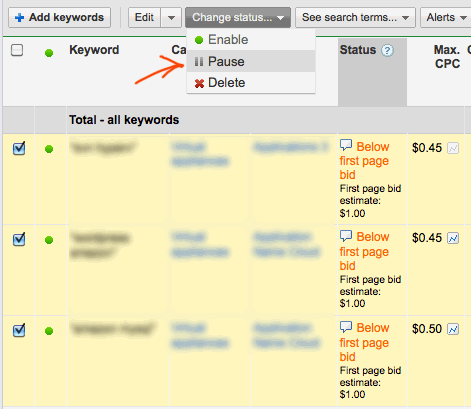
  3. Shift-click on the checkboxes that “bookend” your selection, in this case we’ll just do three. Once selected click the “change status” drop-down and pause these keywords (Note: if you have existing paused keywords they’ll get mixed in when you do this).
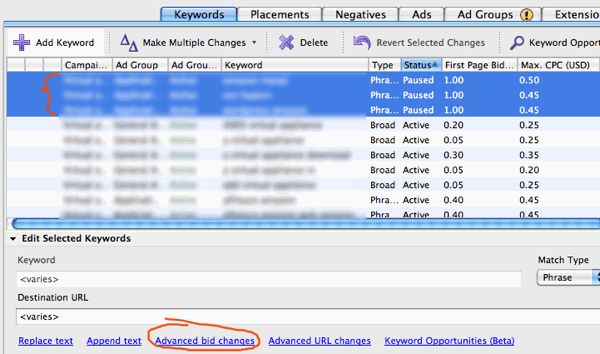
  4. Now hop over to your offline editor, get the latest changes and open up the keywords tab. Sort by the “Status” field and now you’ll have your offending keywords all grouped together. Highlight only the ones you want to bulk edit and then click the “Advanced Bid” link at the bottom.
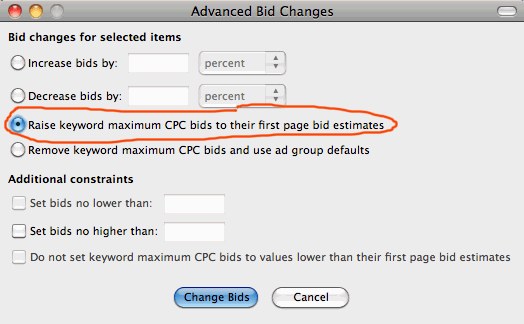
  5. Click the “Raise max CPC bid to first page bid estimate” and bulk apply this change to the ones you’ve selected. Post your changes live and the final step is to reactivate the paused keywords (which should still be selected if you have your same browser window open).

Obviously this technique is overkill if you only need to update 3 keywords. But if you’re dealing with 4000 and need to adjust the bids on 150 (which is the situation I had today) it’s a great time saver. Mad props to the developers that created the offline editor – it’s massively helpful.

Sep 29

Very simple: make it possible to loan a digital book to a friend. Not authorize the same book simultaneously across multiple computers on the same account, but actually de-auth it from one and give it to someone else.

IMHO the first service to do this becomes the dominant eReader format and here’s why: this is the last inadequacy that still drives people like myself to purchase physical books. The reading experience of eReaders has become adequate in every other respect and has other added advantages like search, portability, convenience of sync across multiple devices, instant gratification of being able to download immediately, etc.

I use the Mac client to read Kindle books now and I’ve tinkered with the Apple iBooks. Both are comparable but neither offers this ability to pass a book on after you read it. If there were limitless lending then it could be argued that it would wreck the eBook market and create a secondary blackmarket of people scalping loaned eBooks. But it would also cement that provider’s eBook format as the dominant format and force everyone get an account on their system. Because they still control the auth/de-auth lending process they could mitigate this problem by throttling the frequency or absolute number of times a book could be lent.

This opens a lot of doors. A lot more people would start buying eBooks knowing they could later loan them (for me personally there would never be reason to purchase a physical book again). Once everyone is using their format they make it so easy to purchase new books that whatever sales they lose from people passing on a loaned copy would be more than made up for in new eBook sales. They gain the opportunity to sell into a massive new base of account holders who are lured in initially by the prospect of a free book loan from a friend who already has an account. And they get a HUGE amount of useful data from tracking the reading behaviors and the lineage of lending. Lastly, they enable a crazy new capability if they make it so annotations can be separated from the lent copy and shared across other copies. For instance I would love to be able to subscribe to Derek Sivers’ book markups and flip on his annotations to see the notes he made while I’m reading one of the books on his list. This type of “co-reading” makes it possible to read not just the author’s message but select people’s takeaways inline.

With the release of iTunes 10 and the Ping service, Apple has finally added a social layer to its media player. I would expect eventually the social layer which is being rolled out around music will extend to all forms of their digital content be it a book, movie, TV show, song, podcast, or whatever comes next. Once the loaning capability is baked in, game over. Amazon should preemptively strike and enable this for all current Kindle owners. Turn all the old eBooks currently collecting dust on the proverbial digital shelf into a powerful, free viral campaign for its current subscribers to signup their friends.

Is there a flaw in this strategy or does this seem like an obvious move to anyone else?

Sep 16

Check out the full list of Google services and then think about one that’s not on there now but that could be in a big way: Google Soulmate Finder. If you subscribe to the notions that a) there’s a person out there who uniquely complements you and b) it’s possible to qualify/quantify experiences, traits & behaviors to identify that person and match him/her to you, then Google is in probably the best position of anyone to help you find your soul mate.

Here are the four main reasons why they could (and may choose to at some point) pull this off:

  1. Hands down they have the most comprehensive, indexable data set of both explicit and implicit behavioral, personality and intention info in the world. And they have it for a huge population. Folks drink the Google Koolaid in varying degrees (I would be best classified as an intravenous Google Koolaid consumer at this point) but for even the people who only use search, they have access to an incredible amount of material that could be mined for insight into what makes one tick. For instance, for users of Gmail & Google Apps they know: where you’ve been, what you care about, who you correspond with, activities that define you, etc.
  2. Their core expertise is in serving relevant results – they rule at pattern matching and developing algorithms that weight results based on what’s working. Their whole search business revolves around improving the quality of results that are delivered and they have more expertise than anyone on refining results via empirical data.
  3. Were they to offer a matchmaking service they would have access to a pretty interesting feedback loop by virtue of knowing how things worked out. Their matches might suck at first but pretty quickly the AI could validate which algorithms yielded successful results because they’d know which people stayed together. Other matchmaking services have to rely upon explicit input from the participants to know how well the suggestions worked – Google has data that gives them this implicitly. That means the speed and accuracy with which they could iterate their algorithms isn’t gated by reliance upon explicit feedback from participants.
  4. They’re motivated to do things that draw in new users & drive increased usage across all services. Their stated goal is to index the world’s info and make it more accessible. Anything they can do that gets more people hooked on using their services helps their cause. The matchmaking service would be a killer app for both attracting new people and getting existing ones to further embrace all the Google services. If they reliably demonstrated a string of successes in matching people, I guarantee you’d see a bunch of the people that currently subscribe to paid dating sites flock to the Google equivalent if it were a) free and b) more effective. Provided Google sold the story well about “the more you do on our system, the better the quality of our matches will be,” those new users would be heavily motivated to go all-in on using Google services. They would pick up not just new users but die-hard ones motivated by the promise of finding their soulmate.

Now my hunch is that a significant countervailing force here that prevents them from doing this now is the “creepiness factor.” It would make it all too real how much they truly know about you if they were to offer this service today and it might actually have a detrimental effect of driving users to defect from their service. This is definitely something that changes with the times though, we’ve seen the “boiling frog comfort” effect in the last four years with Facebook. Kids growing up today will have never known life without exposing everything via social networks and may be more comfortable with this type of service. At any rate, if you see a heart icon and the “Google Matchmaker” app appear on Google labs, you heard the prediction here first ;-)

Jul 16

Here’s a neat feature I discovered today with smart playlists in iTunes that automatically keeps some fresh music on your iPod. If you’re like me you initially sync’d a bunch of songs to your iPod/iPhone when you first got it and haven’t changed the music since. You have the new stuff via the “recently added” playlist but there’s a huge body of older music that resides exclusively on your computer in your iTunes so it never sees the light of day on your iPod. Here’s a technique to automatically keep your iPod fresh:

  1. In iTunes go to File > New Smart Playlist and create the following rule:

    Name that playlist something like “fresh songs.”
  2. The way mine is set up I have playlist called “iPhone” and my iTunes is set so it selectively syncs only that playlist to my iPhone. So now drag the “fresh songs” smart list on top of the “iPhone” list.

Now each time you sync it will scan your library and add 50 random new songs you haven’t listened to in the last 6mos. You’ll have a rotating body of new music at all times on your iPod.

Another suggestion for escaping a musical rut if you’re in one is to try the Rdio service. I was on their beta for a few months and I’m now a paying customer. I highly recommend their service. It gives you all-u-can-eat streaming music and works great on the iPhone. It even has the capability to sync songs for offline use so you can listen to them on an airplane. I’ve found the coolest aspect is the spontaneity of being out with friends when someone says “remember that one song” and being able to pull it up and play it on the spot. If you want an Rdio invite leave a comment – I have a few left to give.

Tagged with:
May 27


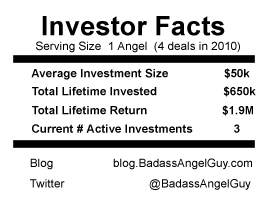
Here’s a simple proposal: if you’re calling yourself an Angel Investor at an event, you should wear a standard name tag that gives an objective measure of some basic facts about your “nutritional content” as an Angel.

At least in AZ, the term “Angel” seems to have been co-opted by anyone who has ever bought a piece of real estate. After holding a piece of dirt and making money, these people are somehow magically imbued with divine powers to forsee why your technology startup won’t possibly work (and they’re happy to prognosticate about it).

I was at an event last night helping a friend pitch his company and one of the panelists (who shall remain unnamed) made the repeated feedback to the presenters that “you didn’t specify what my return will be.” Sir, frankly if that’s the only feedback you have for these entrepreneurs pitching their early-stage, pre-revenue technology startups, you do not deserve the title Angel.

Go buy a treasury bond and the bankers will happily explain what your return will be.

At this stage in the search for the repeatable scalable business model, companies have no f’ing clue what the return on your $50k is going to be. And it’s a silly tapdance you put them through when you force them to fabricate and justify one. The idea is to make it as big as possible – we all agree on that right?

If you’re a VC adding fuel to a finely tuned business model where the formula has been determined and tested, by all means ask the entrepreneur to calculate and substantiate what the return will be. At that point that exercise makes sense. But at this pre-revenue stage by asking this question you’ve self-identified yourself as being unsophisticated, focused on the wrong motivation of Angel-stage investing and frankly you’re not someone whose money I would want at that point. At the Angel stage the entrepreneur has demonstrated the ability to create a product which appears viable. You’re funding their search for the repeatable scalable business model, not putting gas in the engine of a working model. Think of it as a more interesting/rewarding alternative to throwing your $50k down on a craps table in Vegas. If you’re treating it like a blue chip stock and can’t afford to lose that money you shouldn’t be doing Angel investing.

Note: I’m not proposing regulation on Angel Investing, I’m proposing a standard for Angels self-reporting some basic traits to the folks who are pitching you. This objective label would do two important things: 1) for the budding entrepreneur, it gives him/her the ability to assign a level of credence to the words coming from the person telling them why they’re going to fail. 2) for the Angel, it forces them to admit publicly how many deals he/she actual does at the end of the day. The guy with the “Deals last year = 0” label on his breast pocket will likely think twice next time before he publicly craps on a guy starting a company for the first time.

preload preload preload