Mar 26

is a fancy term for the phenomenon that explains the bystander effect. I first learned about it a year ago when I read a book written by a local ASU professor called Influence: The Psychology of Persuasion. Of all the interesting ideas in that book, I’ve seen this one confirmed at least weekly in my own life and as recently as yesterday. In an emergency situation, understanding the concept of pluralistic ignorance, the bystander effect and how to slice through them could prove life-saving.

The extreme example that illustrates the concept of pluralistic ignorance (PI) is the 1964 murder of a woman in NYC. This lady was stabbed to death in broad daylight over the course of two hours and the act was witnessed by no less than forty bystanders, yet nobody did a thing to intervene. Understandably, there was a huge stink in the media following the murder- "how could forty people let a gruesome event like this occur in plain view?" The conclusion at the time was that clearly society was in decline and people were simply becoming apathetic to others’ problems (?!?). Subsequent research, however, supported the PI theory that in situations where one is confronted with uncertainty, he/she checks the reactions of peers for cues on how to respond. When other bystanders exhibit calmness, the observer that thinks he/she is the only one who finds the situation disturbing reserves those doubts internally and expresses false calmness to fit in. Strange self-feeding anomalies like the NYC murder can occur because this "groupthink" pseudo-acceptability perpetuates itself amongst observers and actually strengthens the effect as more people join in.

Just yesterday in boarding a SWA flight on my way home from Lake Tahoe I experienced this effect firsthand. I was engrossed in the final pages of the latest Michael Crichton thriller and had missed the announcement for my section to board the plane. It was a full flight and when I looked up there was still a ton of people directly in front of me and I couldn’t be sure if my section had boarded already. I grabbed my gear and rushed to the group of people in front of me if they had already called the "A’s." About eight people must have turned around and just stared at me- not one person responded. It was an awkward moment returning the blank stares of these folks. Remembering the PI effet I raced over to a different line and singled out one guy and asked the same question. The people with him turned first towards me and then towards him and he immediately responded that they had in fact called the A group already. While this was clearly not a life-and-death situation, it does demonstrate an important lesson:

My TakeawayIf you ever find yourself in an emergency situation and need immediate help from a bystander, resist the temptation to call blindly on a group of people for assistance and instead meet the gaze of one person, single that person out and call upon them for assistance within earshot of the others. Intuitively it would seem that the shotgun approach of calling on a larger group would yield more likelihood of grabbing someone’s attention, however, it has the opposite effect of setting stage for this abdication of responsibility to occur. By singling one person out publicly, you put the PI effect to work for you and create a situation where that person is now center stage in front of the others and at the very least will respond with concern and consequently generate more concern in the observers. This causes a self-feeding positive spiral that you want to occur. What’s interesting is that there is this focal point that is the reaction of observer #1 that is the fine line between a downward spiral towards complete apathy of the other bystanders vs. an upward spiral of a convergence of many people trying to help. If there’s a side you want to err upon in a crisis it’s clearly the latter and understanding the PI effect can be critical towards creating that response.

© 2005 Lights Out Production – All Rights Reserved Worldwide
Mar 15

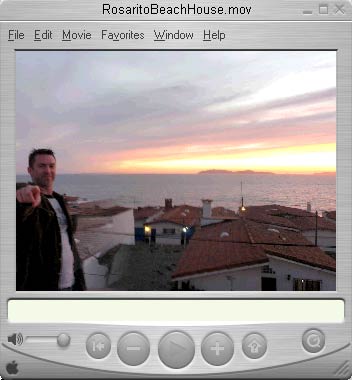
Quicktime Virtual Reality Panoramas are immersive scenes that show a 360deg view of one’s surroundings. There are high-end solutions for creating these scenes that utilize special optics and tripods but you can also create a decent one using the digital camera you already own. I’m down in Mexico once again working from the road and enjoying spring break. My buddy Dave has a beach house here in Rosarito and a few of us shot this QTVR last night from his rooftop:

Here’s the simple recipe for how we did it using my Canon SD550 digital camera:

  1. Setup the scene – You’re going for 30deg separation on each shot – you need a way of aligning the scene so you can shoot 12 images equidistant around the “clockface” where you are standing. If you’re in sand you can actually draw a clockface on the ground and align each shot on its corresponding numeral, otherwise you’ll need to find orthogonal objects to give you a reference for the “12, 3, 6 and 9” positions and estimate 1/3rd the distance between each for the intermediary pics. I was standing on tile so that made it easy.
  2. Shoot the pics – the goal is to produce a sequence of images in perfect vertical alignment with a minimal change in brightness amongst each pic. Hold the camera vertically, focus and shoot one pic on each of the twelve numerals of the clockface. If you’re on a slope, you want the camera perpendicular to the sky and not to the slope (if you position relative to the slope you’ll end up with a QTVR that looks like a sine curve). I generally disable the flash unless there’s bright sunlight raking from an angle and you need to compensate for the objects in shadow. You want to hold the camera at the same vertical height as you spin around.
  3. Produce the movie – there are tons of options but I found a $70 shareware windows app called Panorama Factory by Smoky City Design that does an amazing job of intelligently splicing the photos to produce the final scene. Import the twelve photos you just shot into the program and follow the cues in the wizard using all the standard defaults. You’ll need to rotate your sequence of images unless your digital camera does this automatically for you – Panorama Factory has an option on import to do this automatically. You’ll step through a series of about 6 screens on the wizard and arrive at a point where it lets you save the final image. Choose the QTVR option and jpg compression and adjust the slider for quality depending on the delivery format (CD or Web) and how small you want to make the final file.

That’s it. Once you perfect the process of creating the QTVR, try experimenting with the advanced hotspot features to create a series of linked scenes that make a full virtual tour. Some camera vendors bundle QTVR software with their products – it’s probably a good idea to check the software that came with your camera before buying anything extra.

© 2005 Lights Out Production – All Rights Reserved Worldwide
Tagged with:
Mar 06

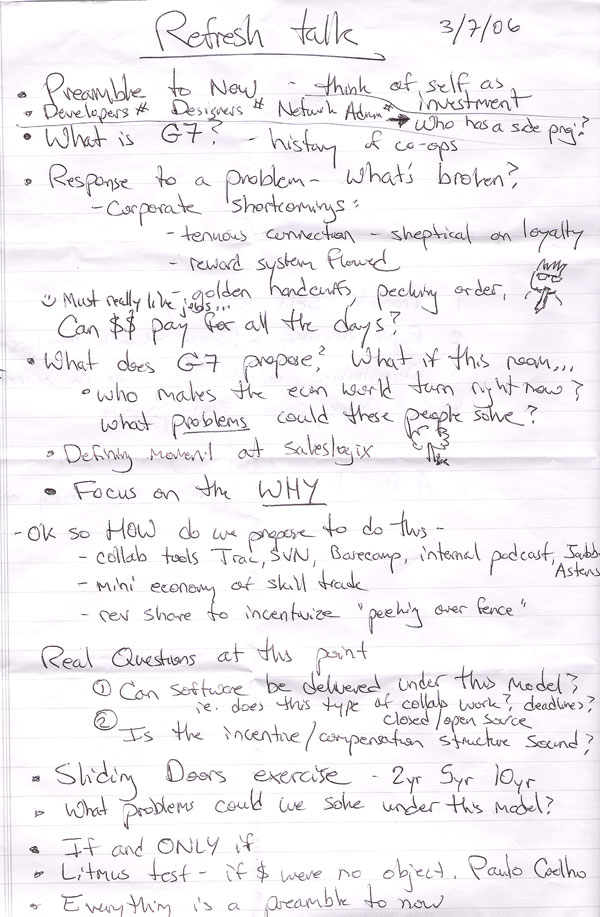
I spoke at the Refresh Phoenix meeting last night for an audience of about 25-30 people. We talked about the traditional paradigm of work in the corporate enviornment, the flaws associated with it and what Grid7 proposes to solve these. I posted my scratchpad outline for the talk here so you can skim the content. I taped it using the iPod and made the audio available below. The questions are a bit difficult to hear since we didn’t use microphones but all in all it seemed to be received well and generated a lot of discussion afterwards. Thanks to everyone who attended and asked questions. You can listen to the audio here.
© 2005 Lights Out Production – All Rights Reserved Worldwide
Mar 03

Most self-improvement programs suggest that the first steps are to:

  1. write down a list of your short-term and long-term goals
  2. post them in a conspicuous place

Doing this puts several things to work for you: First, when you write something down, the act of writing itself causes your brain to use different neural pathways. Odds are you could care less about which neurons you use to get something done, but you’d probably be interested to know the effects that research has shown writing to have on memory, cognition and creativity. Additionally, when you write your goals down you are forced to quantify and qualify them in ways that do not occur when you simply think to yourself “it’d be nice if i could do xyz someday…” Writing out the goals generally requires that you to think through the path towards achieving them as well. It gets you 100% clear on your intent (the “why”) and that is the strongest motivator you can possibly bring to bear. Anything you want to improve, you must first be able to track- this exercise clarifies exactly what you’re tracking from now on. The last thing you enact by exposing your goals publicly is peer pressure- when you post them on your bathroom mirror or on your bedroom wall or even in your cube, you tap into the same advantages that come with having a workout partner at the gym (ie. thinking to yourself, “i can’t skip today because i’ll be letting so-and-so down”). Peer pressure is typically conceived as a _bad_ thing but in this context I would argue that having other people aware of your goals will compel you to take steps necessary to meet them that you otherwise would not have. Posting goals in your workplace is a start but there’s a better, more conspicuous place to post them…

So in a bit of a social experiment, I’m proposing a meme centered around exposing your goals publicly for the next year and beyond. At the very worst – it’s comedy, you miss the mark on everything and nobody remembers the post a year from now. At the very best – it’s a living post that changes as you attain goals, an exercise that is the catalyst for some greater focus, and a neat way to peer over the fence and see what is important to other people (and prod them towards reaching their own goals). If you choose to participate, this is what you need to do:

  1. post a list of your short-term and long-term goals on your blog and mention who tapped you for the experiment. The goals you list don’t have to be technology-specific or anything-specific really- just stuff you want to want to eventually achieve. Aim high here, really ponder what you want to achieve someday, what you want your life’s work to be, and then write it down. Try to make the list as close to the chronology as you see it playing out- make it so it starts with the most short-term/atomic/realistic goals and let it wander to the most ambitious / wacky / long-term dreams
  2. use the title “opensource goals meme” so that other people can do a search and find the other participants. copy these instructions somewhere in the post or refer them here
  3. tap 5 friends to do this exercise after you are finished and actually READ what they write and REFLECT how their priorities are similar and different from your own
  4. maintain this list as you go crossing off things as you achieve them and adding new ones as they develop

So my list is perhaps a bit on the exhaustive/ambitious side but it’s been building in my Treo over the past year:

learn decision tree analysis
get accepted to the 9rules network
learn how to kite surf
learn to paraglide
learn morse code
reconnect w/ old friends on working US roadtrip
down-size, consolidate and turn house and convert to performing asset
get back to single-digit bodyfat
organize barcamp phoenix
regain flexibility
work for myself
cook 90% of all meals- less eating out
grid7 retreat w/ core intellectuals @ tonto natural bridge
achieve 1000 WPM reading speed
write for a reputable publication
learn yoga
become an employer
learn krav maga
buy a beachfront condo somewhere tropical
play “Panama” live on stage w/ Van Halen
take the bob baunderant school of racing
hold summer “cabin codefest”
produce coldturkey’s next album
get scuba certified
build a home recording studio
create a revolutionary billion dollar company
make the homepage of slashdot
drive from alaska to chile (fireandicetour)
learn to surf
make the “backs of giants” mural
learn accounting principles & tax law
learn tai chi
publish a kid’s book
learn to fly a helicopter
liberate 100 people from shitty jobs they hate
take down a major bully
develop a highschool curriculum
learn handwriting analysis
do a wilderness survival school and survive 1 wk in wild
start a VC firm
study all the major world religions
read all the Great Books
travel to all 7 continents
launch VELA project in phoenix
serve abroad in the peace corps
learn feng shui fundamentals
summit large mountain
speak at a major conference
complete the chronos custom nutrition program
complete a marathon
earn para3 rating and fly torrey pines
make the cover of WIRED
earn a PhD in biomimicry
beat the champion level of scrabble
meet the Dhali Lama in person
raise a child
x-country paragliding trip in either chile or australia
win pulitzer
redistribute the wealth based on merit
visit outer space
find cure for a major mental illness like depression
earn nobel prize

Ok, so granted they get wildly ambitious towards the end ;-) but my friend Don always said “goals are dreams with a deadline.” Never stop dreaming big, right?
Kimbro Staken, Steven Harvill, Rob Brooks-Bilson and Chris Tingom – you’ve been “tapped” ;-)

UPDATE: a few more people I’m tapping on this meme- John Blayter, John Bland, Max Porges, Noah Kagan, Francine Hardaway, John Murch

UPDATE: 6/16/06 – Held Cabin Codefest in Munds Park.

UPDATE: 8/1/06 – Became an employer (hired Ben as our first full-time employee)

UPDATE: 10/15/06 – completed the PADI scuba class

UPDATE: 12/15/06 – Got accepted to 9rules and organized the 1st Barcamp Phoenix

UPDATE: 1/5/07 – Had my first kite surfing course – woohoo!

UPDATE: 3/9/07 – Published my first book

Mar 02

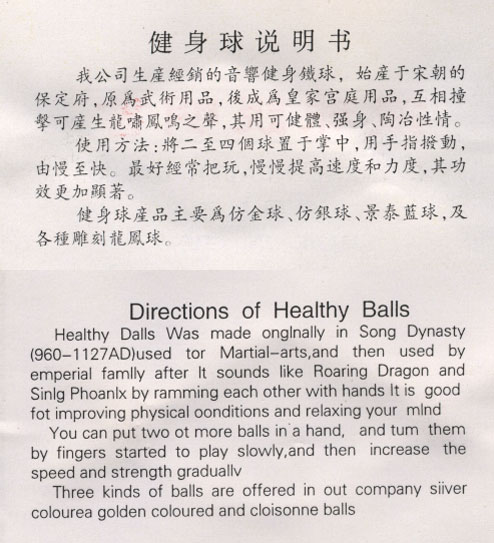
This is just too awesome to not post- I was in a Japanese antique store yesterday getting some furniture for our office and I saw some of those clangy metal spheres you twirl in your hands that supposedly help you relax. After reading the instructions I had to buy them:

Dude, you had me at "Dalls."

A funny site that aggregates these kinds of mis-translations is Engrish.com– check it out.

Feb 23

Hopefully this trick is useful to anyone doing taxes right now and using MS Money. MS Money is probably the only M$ product I really like. I switched this past year from using Quickbooks to running all my accounting through MS Money and it’s been _way_ easier. I don’t know the proper accounting jargon for how they’re different (as far as I understand, both are double-entry accounting programs but MS Money just auto-handles one side of the equation and assumes it’s crediting cash). Both can integrate with your bank account but I never figured out how to do what I wanted with QB which was to NOT have to enter each transaction manually in two places. MS Money pulls transactions automatically from my bank so all I have to do is go through and reconcile with my paper bank statement at the end of the month so that means less work. Plus it can be “taught” what categories the expenses are and it gradually learns to categorize them on its own. Anyways, this is not a commercial for a M$ product though- it’s a tip for creating a report which they don’t give you out of the box.

Your accountant will probably ask you for a general ledger first thing. For whatever reason MSMoney does not have this as a canned report and looking all through the Microsoft.com site and googling for a tutorial on how to do create one produced no results (I’m using 2003 Deluxe btw- I read all kinds of bad reviews of the latest version). So we waded through a few of the report screens until we figured out how to customize one of the pre-packaged reports to give us what we needed. Here’s what we did:

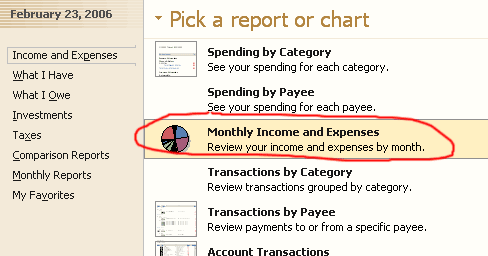
Fire it up and go to the reports tab:

Choose the Monthly Income and Expenses report:

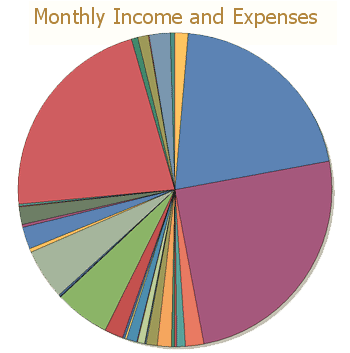
You’ll get this ridiculous pie chart (which is about as useful to your accountant as a fingerpainting – that’s okay, we’ll fix it).

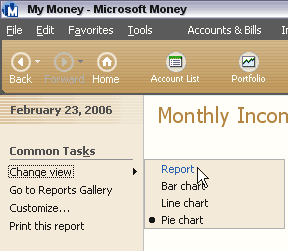
In the left menu, change the view from Pie chart to Report

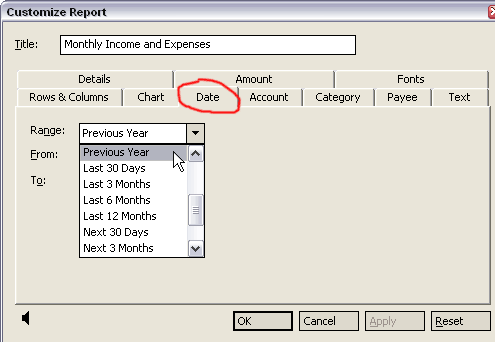
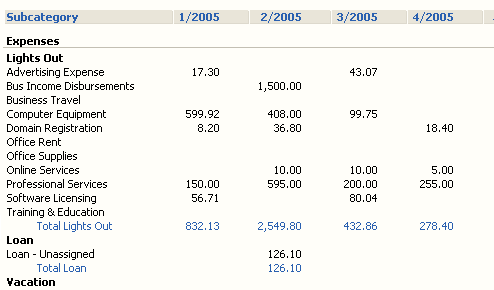
This gives us tabular data but is still not useful because we need to specify the date range:

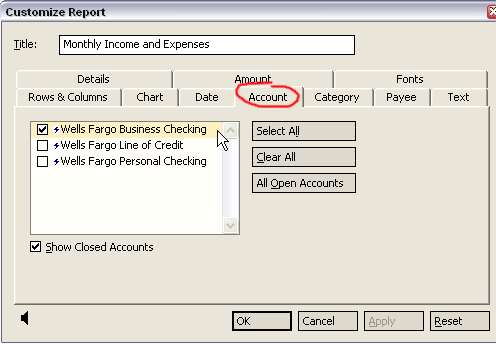
We also need to limit the report to pull from only the account we’re interested in. I have both my personal and business accounts connected to MS Money which is nice for managing things in one place but for the purposes of reporting your business taxes, clearly you want to separate them out.

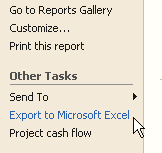
Okay, good deal- so now we have a general ledger report within MSMoney for the business account for the past year. This doesn’t do my accountant any good though since he doesn’t have this program. We need to export this report to excel.

On the left menu, yea…

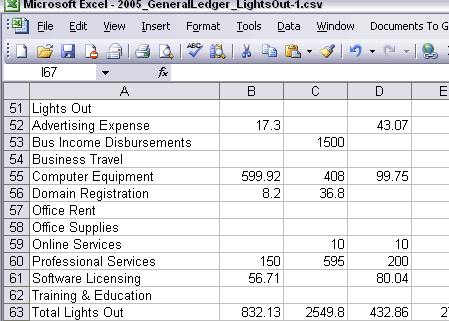
And there you have a pretty spreadsheet that contains all the data from our MS Money report and that can be used by any accountant who has excel (and even notepad, but then again if your accountant doesn’t have excel, you’ve got bigger issues ;-)

I’m sure Quickbooks is more appropriate for some businesses but mine is pretty simple and for me the priority is minimizing the time I have to devote to tedious tasks like data entry and still retain useful reporting features and being able to give my accountant whatever as needs as quickly as possible. HTH

-sean

© 2005 Lights Out Production – All Rights Reserved Worldwide

Tagged with:
preload preload preload